Hi Folks,
I've decided to try and consolidate my blog postings to my organizations web site www.datacenterpulse.org.
Data Center Pulse is an organization I founded with my brother-in-law. The goal of this community is to track the pulse of the industry and influence the future of the data center through discussion and debate.
I look forward to continuing the discussion and debate from this new location.
Regards,
Mark
Sunday, June 21, 2009


Monday, May 25, 2009
What does the Cloud Look Like?
With all the talk about clouds, you'd think we would have a simple definition by now. However, since we don't I'm going to take a quick stab at what I think the different cloud types are and why their distinction is important.
Cloud Types:
Flat, Vertical, or Rainbow (I'm sure I'll come up with others later)
Flat: Amazon or Google clouds
These are clouds that represent a flat cross section of applications that are largely defined as Web 2.0. They are built around tools like Java and other web technologies.
Simple effective way of delivering and managing Web 2.0 applications in an efficient scalable environment. It's relatively easy to move or build new applications to take advantage of this cloud and make it available via the internet over any browser.
Problem:
Most companies have vertical applications. These are applications like Oracle, SAP, Seibel, Exchange and others that are not built on Web 2.0 platforms. These applications can't just be shipped out of your company's data center and installed at Google or Amazon. Nor can you send them your data to have it loaded to their platform. The work flows, database integration, third party application integration and other proprietary development make these applications unsuited for life on a Web 2.0 platform.
Vertical Cloud:
These are clouds built to deliver a specific application vertical or work flow. Salesforce.com might be considered an example of this cloud. Although a more definitive model would be SAP or Oracle selling SAAS (Software as a Service).
Pick the best of breed solution that accommodates a specific set of applications needed by your organization. You will still gain many of the benefits of the cloud in the sense that you will have a highly scalable environment that "should" allow you to only buy what you need when you need it.
Problem:
Depending on the solution there may be issues with integration into other applications you have. Your upgrade or patch cycles might become significantly more complex as you'll be negotiating time and process with your cloud provider. However, with time I'm certain these issues would be worked through.
"Rainbow" Cloud:
The All Inclusive Cloud or Tolerant Cloud. Personally I like the idea behind the rainbow cloud, as it allows companies to move into it one application or service at a time with the assumption that they can eventually load their entire set of applications into the environment. This cloud is best defined today by VMware's Vsphere solution.
Provides a platform that can accommodate all of the applications in your current environment, from legacy to Web 2.0. You also gain the flexibility of scale (up and down), portability (move from location to location easily). In this type of cloud environment your benefits increase with every application you add. You also simplify your support requirements as you don't have to have multiple providers/solutions supporting your virtualized systems.
Problem:
This is still a new platform as are all Cloud offerings so your choices must be made with care. My suggestion is to take the low hanging fruit approach of moving your low risk applications first and thoroughly testing how the environment performs and is supported (especially important if you’re buying cloud services as opposed to building an internal cloud). Over the course of 12-18 months use your natural update/replace cycles to help you move the rest of your environment.
Comments are welcome as always!
Friday, May 1, 2009
Cloud Computing will Drive the "Aware" Data Center
The physical structure of real cloud doesn't have a fixed border and it can easily change. This design characteristic should also be applied to a compute cloud.
If the "Cloud" isn't a fixed location, or shape, how then does it fit in today's overbuilt data centers? The simple answer is, it depends. In many cases the "Fort Knox" or "Maginot line" data center of today doesn't make sense in a cloud enabled world. So what should the strategy be, I suggest that flexible, highly sensored, relatively low cost, but geographically dispersed data centers are where we should all be headed.
Data Centers should be built low cost but very well monitored and measured. Your application availability protection will be designed into the "Cloud" platform. This means you can build two data centers for less than the price of one high availability facility. It also means that with two facilities you can enable geographic diversity to help protect against disasters.
Now for the cool part. I believe our next step in the evolution of the Operating Environment or Cloud platform will be the integration of the "Platform" with the building management systems. The benefits of tying the two things together is that now your Data Center team will have visibility into the entire system and the system can be trained to protect itself. That's right, when the data center facility is failing it can tell the "platform" to move critical applications to a sister facility. This strategy of tying the building and the IT platform together will create a number of opportunities. The opportunities associated with an "Aware" data center are higher application availability, lower staffing requirements, much lower cost of ownership, and a system that can support and protect itself much faster than a person who has to be woken up at home.
I'll be talking more about this "system" approach to a cloud data center in the near future.
If the "Cloud" isn't a fixed location, or shape, how then does it fit in today's overbuilt data centers? The simple answer is, it depends. In many cases the "Fort Knox" or "Maginot line" data center of today doesn't make sense in a cloud enabled world. So what should the strategy be, I suggest that flexible, highly sensored, relatively low cost, but geographically dispersed data centers are where we should all be headed.
Data Centers should be built low cost but very well monitored and measured. Your application availability protection will be designed into the "Cloud" platform. This means you can build two data centers for less than the price of one high availability facility. It also means that with two facilities you can enable geographic diversity to help protect against disasters.
Now for the cool part. I believe our next step in the evolution of the Operating Environment or Cloud platform will be the integration of the "Platform" with the building management systems. The benefits of tying the two things together is that now your Data Center team will have visibility into the entire system and the system can be trained to protect itself. That's right, when the data center facility is failing it can tell the "platform" to move critical applications to a sister facility. This strategy of tying the building and the IT platform together will create a number of opportunities. The opportunities associated with an "Aware" data center are higher application availability, lower staffing requirements, much lower cost of ownership, and a system that can support and protect itself much faster than a person who has to be woken up at home.
I'll be talking more about this "system" approach to a cloud data center in the near future.
Sunday, April 26, 2009
Cloud Computing Too Expensive?
I don't get it, where is everyone getting this idea that cloud computing will be too expensive? Ive read this in several locations now and just don't get it.
Cloud computing has many definitions as we are all starting to better understand. However, to me there is one guiding premise and that's "Efficiency". Efficiency is followed closely by scaleability and availability. The most interesting thing about those three words being together is that they can all be true if the cloud is architected correctly.
Why would we pursue the cloud option if it didn't buy us something? The question is "does it buy us something that is more than we currently have or just an alternative?"
To me the cloud represents an opportunity to make a small business' IT more like a large business. With the cloud the idea of geographic diversity and high availability should be a given. Neither high availability nor geographic diversity are a given for most small organizations. A traditional IT shop has to make pragmatic desicions about how much it can afford to do with a very limited set of IT and corporate resources. Generally that means delivering basic IT services, which most often doesn't include redunancy or easy disaster recovery or even better easy disaster avoidance. IT in small companies also has difficulty providing services to employees in far flung locations and even if they do, supporting them is a costly prospect.
So here's another question:
If you can build a replacement IT environment that does everything your old environment did for a similar or slightly higher cost all while enabling some of the additional benefits of high availability, redundancy, lower cost of ownership, and geographic diversity, wouldn't you want to do that?
To me high cost means I pay more for one thing than I do another but receive the same benefits. High value is when I can pay roughly the same cost for something new as I did for something old and reap many additional operational and strategic benefits. I've often heard people complain that VMware virtualization was expensive and I always ask "as compared to what?". How can something that drives down your cost of ownership and whose ROI is often times measured in months not years be considered expensive? The same should be true for the cloud!
If your cloud provider can't demonstrate how they can provide you a service with capabilities that exceed your current environment and do it for the same or less than you could, then they're probably doing something wrong!
More of the cost benefit of cloud next time.
Cloud computing has many definitions as we are all starting to better understand. However, to me there is one guiding premise and that's "Efficiency". Efficiency is followed closely by scaleability and availability. The most interesting thing about those three words being together is that they can all be true if the cloud is architected correctly.
Why would we pursue the cloud option if it didn't buy us something? The question is "does it buy us something that is more than we currently have or just an alternative?"
To me the cloud represents an opportunity to make a small business' IT more like a large business. With the cloud the idea of geographic diversity and high availability should be a given. Neither high availability nor geographic diversity are a given for most small organizations. A traditional IT shop has to make pragmatic desicions about how much it can afford to do with a very limited set of IT and corporate resources. Generally that means delivering basic IT services, which most often doesn't include redunancy or easy disaster recovery or even better easy disaster avoidance. IT in small companies also has difficulty providing services to employees in far flung locations and even if they do, supporting them is a costly prospect.
So here's another question:
If you can build a replacement IT environment that does everything your old environment did for a similar or slightly higher cost all while enabling some of the additional benefits of high availability, redundancy, lower cost of ownership, and geographic diversity, wouldn't you want to do that?
To me high cost means I pay more for one thing than I do another but receive the same benefits. High value is when I can pay roughly the same cost for something new as I did for something old and reap many additional operational and strategic benefits. I've often heard people complain that VMware virtualization was expensive and I always ask "as compared to what?". How can something that drives down your cost of ownership and whose ROI is often times measured in months not years be considered expensive? The same should be true for the cloud!
If your cloud provider can't demonstrate how they can provide you a service with capabilities that exceed your current environment and do it for the same or less than you could, then they're probably doing something wrong!
More of the cost benefit of cloud next time.
Monday, April 20, 2009
Oracle Acquisition of Sun Microsystems Interesting!
The topic of corporate acquisition strategy doesn't normally make it into my blog, but I couldn't help but make a few comments about the Oracle acquisition of Sun.
My first thoughts after seeing the headline at O'dark 30 this morning was, good idea! Larry can now take over the only available competition for his DB (MySQL) and find more ways to expand on Java in his current and future solutions. This seems like a win to me. Then I read more and found out that Larry wants to expand into the hardware market and attempt to sell the whole kit and kaboodle, hardware & software into the data center. This, I believe is a failed idea. In pursuing this agenda Larry is literally going back in time. The entire world is moving towards the cloud. In the next two years the hardware layer will become even more commoditized that it is already. Why would you want to invest in your own hardware, when you can sell your software on everyone else's solution?
Just my 2 cents. I'd love to get everyone's thoughts on this.
My first thoughts after seeing the headline at O'dark 30 this morning was, good idea! Larry can now take over the only available competition for his DB (MySQL) and find more ways to expand on Java in his current and future solutions. This seems like a win to me. Then I read more and found out that Larry wants to expand into the hardware market and attempt to sell the whole kit and kaboodle, hardware & software into the data center. This, I believe is a failed idea. In pursuing this agenda Larry is literally going back in time. The entire world is moving towards the cloud. In the next two years the hardware layer will become even more commoditized that it is already. Why would you want to invest in your own hardware, when you can sell your software on everyone else's solution?
Just my 2 cents. I'd love to get everyone's thoughts on this.
Sunday, April 19, 2009
The Data Center is a System & The Data Center Stack
At the recent Data Center Pulse Summit we created the Top Ten. One of the items making the list was the "Data Center Stack" and in my last post to this blog I referenced the "Data Center as a System". The Stack epitomizes the argument that the data center needs to be looked at holistically as an entire system. Only when the data center owner understands top to bottom what makes up his/her data center will we truly be able to effectively manage the data center as an efficient resource.
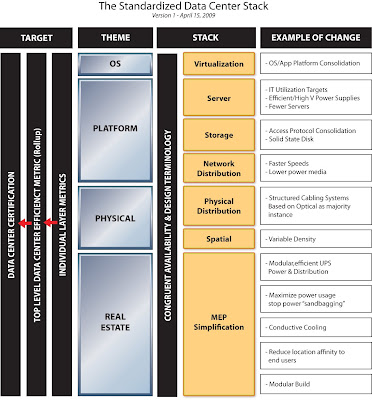
Whether you're concerned about where your power comes from (is it clean or how much loss does it suffer due to distance) or how a new blade chassis might affect your cooling, there's no way to deny that almost every aspect of the modern data center is linked.
The best way to get efficiency out of a system is to have a single owner. I'm proposing that all companies should assign a single "Data Center Owner". Ideally this person is someone who has a decent background in IT infrastructure, but also has interest or affinity for efficiency in general. Once this person is assigned you are much more likely to start collecting information about your "System" that encompasses the entire "Stack" Only then will you know what your system is costing you and what specific changes will mean to the performance of the system.
I would love to hear your thoughts on this issue!
Whether you're concerned about where your power comes from (is it clean or how much loss does it suffer due to distance) or how a new blade chassis might affect your cooling, there's no way to deny that almost every aspect of the modern data center is linked.
The best way to get efficiency out of a system is to have a single owner. I'm proposing that all companies should assign a single "Data Center Owner". Ideally this person is someone who has a decent background in IT infrastructure, but also has interest or affinity for efficiency in general. Once this person is assigned you are much more likely to start collecting information about your "System" that encompasses the entire "Stack" Only then will you know what your system is costing you and what specific changes will mean to the performance of the system.
I would love to hear your thoughts on this issue!
Cloud Computing & Green IT is it "ALL HYPE?"
You couldn't find two more hyped phrases in the world of IT if you tried. However, even with all the hype you should still be paying attention.
I've been in IT for over 20 years now and have seen technology become widely available that we wouldn't have dreamed about in 1989. I can remember thinking 1200 Baud on the modem was amazing and that a 1.2 Mb floppy disk was revolutionary. The first data center I worked in was about 1500 square feet and had a fairly large Unisys mainframe system that filled the entire room. This one computer did all the processing for our company of 1300 employees. Unfortunately all the work was scheduled and had to run in sequence, which meant customers would often have to wait a day or more for the results of their work. At the end of the week we would run a full backup of all the information and it would take the majority of a day to complete. Now I can get more compute power and twice the disk space in a hand held device that fits in my jeans pocket. That's right that huge (size) computer only had 16 Gbs of disk, you can easily get 2 to 4 times that much in a device that fits in the palm of your hand now.
In 1998 I can remember telling my workmates that one day we'd be able to treat the computers in a data center as one large computer, now 11 years later it's here in the name of "Cloud Computing". My naiveté of what it would take to make my little hope a reality notwithstanding, the hope was the right one. I have a personal perspective on what the cloud should be, but in the end it's about effective use of resources, better known as efficiency. Efficiency is also where "Green" comes in.
Now what sounds better "Cloud Computing" & "Green IT" or "Efficient, Cost Effective IT". I'm pretty sure I know which one you picked. I'm OK with the use of "Cloud Computing" and "Green IT" because these phrases help to galvanize our attention and interest, so in this case the ends justify the means!
Don't get me wrong there's much more to cloud computing than just efficiency and certainly there's more to it than I imagined when I first considered it in 1998. While there are many definitions of the "cloud", I'm going to focus on my version.
My high level definition of the cloud:
A platform of software that allows the user to utilize multiple computers and their assorted resources of disk, memory and CPU as one larger compute resource and to be able to access this resource from any location.
Why is cloud important in the above definition?
Today most applications are still run in hardware verticals, a defined, tiered set of servers, disk & network devices that support the different unique functions of an application (data base, app engine, web, etc). This configuration leads to very "inefficient" use of hardware resources, especially when you consider extra hardware needed for test and development or recovery. In general the average non-virtualized server in today's data centers is running at <6% utilization! If that's not enough to concern you, how about the other issues associated with this type of vertical architecture; - Lack of portability: Application instances can't easily be moved - Hardware dependence: Changes to the hardware platforms can force changes to the application - Difficulty in creating a new instance: In some cases the infrastructure to make one application work can take days to configure from scratch. Making recovery from failures or corruption time consuming and costly - Resiliency tends to be built into the hardare & data center, not the application - Maintenance of the application or server environment often times means down time for the customers - Each environment pillar/vertical is specific to an application If the cloud works the way it should you can solve all of the problems listed above and drammatically improve your efficiency!
- You'll potentially save millions on your data center infrastructure, while enabling higher availability, improved performance and increased scalability.
- You'll be helping to save the planet, while reducing your company's CapEx & OpEx overhead
If you're not currently looking into how you can leverage the cloud or be greener, then you should at least start by thinking about what you'd like your compute infrastructure to look like 2 - 3 years down the road. You'll probably find that the best place to start is with virtualization.
I've been in IT for over 20 years now and have seen technology become widely available that we wouldn't have dreamed about in 1989. I can remember thinking 1200 Baud on the modem was amazing and that a 1.2 Mb floppy disk was revolutionary. The first data center I worked in was about 1500 square feet and had a fairly large Unisys mainframe system that filled the entire room. This one computer did all the processing for our company of 1300 employees. Unfortunately all the work was scheduled and had to run in sequence, which meant customers would often have to wait a day or more for the results of their work. At the end of the week we would run a full backup of all the information and it would take the majority of a day to complete. Now I can get more compute power and twice the disk space in a hand held device that fits in my jeans pocket. That's right that huge (size) computer only had 16 Gbs of disk, you can easily get 2 to 4 times that much in a device that fits in the palm of your hand now.
In 1998 I can remember telling my workmates that one day we'd be able to treat the computers in a data center as one large computer, now 11 years later it's here in the name of "Cloud Computing". My naiveté of what it would take to make my little hope a reality notwithstanding, the hope was the right one. I have a personal perspective on what the cloud should be, but in the end it's about effective use of resources, better known as efficiency. Efficiency is also where "Green" comes in.
Now what sounds better "Cloud Computing" & "Green IT" or "Efficient, Cost Effective IT". I'm pretty sure I know which one you picked. I'm OK with the use of "Cloud Computing" and "Green IT" because these phrases help to galvanize our attention and interest, so in this case the ends justify the means!
Don't get me wrong there's much more to cloud computing than just efficiency and certainly there's more to it than I imagined when I first considered it in 1998. While there are many definitions of the "cloud", I'm going to focus on my version.
My high level definition of the cloud:
A platform of software that allows the user to utilize multiple computers and their assorted resources of disk, memory and CPU as one larger compute resource and to be able to access this resource from any location.
Why is cloud important in the above definition?
Today most applications are still run in hardware verticals, a defined, tiered set of servers, disk & network devices that support the different unique functions of an application (data base, app engine, web, etc). This configuration leads to very "inefficient" use of hardware resources, especially when you consider extra hardware needed for test and development or recovery. In general the average non-virtualized server in today's data centers is running at <6% utilization! If that's not enough to concern you, how about the other issues associated with this type of vertical architecture; - Lack of portability: Application instances can't easily be moved - Hardware dependence: Changes to the hardware platforms can force changes to the application - Difficulty in creating a new instance: In some cases the infrastructure to make one application work can take days to configure from scratch. Making recovery from failures or corruption time consuming and costly - Resiliency tends to be built into the hardare & data center, not the application - Maintenance of the application or server environment often times means down time for the customers - Each environment pillar/vertical is specific to an application If the cloud works the way it should you can solve all of the problems listed above and drammatically improve your efficiency!
- You'll potentially save millions on your data center infrastructure, while enabling higher availability, improved performance and increased scalability.
- You'll be helping to save the planet, while reducing your company's CapEx & OpEx overhead
If you're not currently looking into how you can leverage the cloud or be greener, then you should at least start by thinking about what you'd like your compute infrastructure to look like 2 - 3 years down the road. You'll probably find that the best place to start is with virtualization.
Tuesday, April 7, 2009
Why Data Centers are Slow to Improve
Since I wrote my last post about the need to improve solution adoption rates in the data center I've had a little bit of an epiphany. While I still believe that my comments were largely correct, I potentially left out the biggest reason we can't easily effect change in the data center and it's because the majority of data centers don't have a dedicated "owner".
When I think of an application owner I think of someone who is responsible for ensuring their application is well cared for at a number of levels.
When I think of a typical system administrator I think of someone who is responsible for the server and it's tools and operating system.
But what do most of us think of when we think of the data center manager. I would venture a guess that it's the man/woman who generally ensures that there's a safe, secure, and available environment for the company's important applications to live in. But what about the "Facilities" manager, isn't s/he responsible for the "Data Center"? It seems we have a conundrum! Who actually owns the data center? No one is the correct and unfortunate answer, and that's not the end of it. In many companies there's not an IT or Facilities person tasked with actually "owning" and "understanding" the data center. How could this be? Don't we know how much money is spent on these facilities, the unfortunate answer is no, in many cases we don't, precisely because we don't have a knowledgeable & empowered owner.
In many small to mid sized companies there isn't the recognition of the overall cost and opportunity associated with running a data center. As such, these companies often don't have anyone looking to improve the system that is the Data Center.

Without a dedicated resource in charge of ensuring the data center is all it can be, how can we expect the environment to improve? Without a dedicated resource there's no one going to Data Center conferences, taking classes on data center management or working with data center peers. In this environment the data center is relegated to being a "special" room. This special room creates a huge but relatively silent sucking sound as it sucks the financial life out of the company and that's not even the bad part! The bad part is that the rest of the world suffers as a result of our general mismanagement of this power and water intensive environment.
It's my assumption that the breakdown of data centers by size & volume looks something like this pyramid:
Without a dedicated resource in charge of ensuring the data center is all it can be, how can we expect the environment to improve? Without a dedicated resource there's no one going to Data Center conferences, taking classes on data center management or working with data center peers. In this environment the data center is relegated to being a "special" room. This special room creates a huge but relatively silent sucking sound as it sucks the financial life out of the company and that's not even the bad part! The bad part is that the rest of the world suffers as a result of our general mismanagement of this power and water intensive environment.
Until we get to the point where IT & Executive management agree on supporting the data center as the critical "system" that it is, we will forever be plagued by the same problems. We (the royal we) leave a tremendous amount of opportunity on the table when we ignore the data center. If we're not going to justify the appropriate support for it, we should outsource to someone who will.
Next time more about the "Data Center as a System"
Sunday, March 8, 2009
Technology adoption in Data Centers is too SLOW!
Why does it take the average data center owner/operator 3-7 years to adopt a technology solution in their data center and why is the issue important to consider?
Today power utilization in US data centers comprises roughly 2-3% of the total used by the entire nation. There are lots of arguments about why this is important or why it might even point to reduced power utilization in other areas (I.e., improved efficiency of booking travel without driving to the travel agents office). However, these arguments really don't matter. The fact remains that our data centers are a huge target of opportunity. This target isn't just because our DCs use so much power, but the fact that the vast majority of our DCs have potential efficiency gains amounting to anywhere from 25% to 80%. If we take the average between 25 & 80 of 52.5% you can begin to recognize the size of the target, it's HUGE!
How does the rate of new technology adoption play into this? Well, many of the solutions available today (Virtualization, Airside/Waterside AC, 480 Volts to the rack, Powering off Servers, Hot/Cold air isolation, etc., etc.) are proven and used in production environments. So, why aren’t we lapping up these technologies like a bunch of hungry junk yard dogs? Unfortunately, that's where it gets a little more complex. I believe there are a number or reasons, like myth, risk aversion, lack of knowledge, higher priority projects, limited or poor integration between IT & Facilities teams, and a large number of data centers without dedicated resource with specific data center roles and responsibilities. We also don’t have a common certification program for data centers, nor do we have a simple way for folks to measure their performance, other than the PUE or DCiE metric created by Green Grid.
Myth:
“I heard that doesn’t work” or “the risk to the environment is high”
Risk Aversion:
The data center is the beating (mechanical & digital) heart of the modern company, and we’re trained not to mess with it!
Lack of Knowledge:
Data Center staff (IT & Facilities) aren’t given the opportunity to learn more about what it takes to own a data center and own it efficiently.
Higher Priority Projects:
While in many cases there are projects that are “higher priority”, I believe the reality is that IT & Facilities often don’t truly understand the potentially opportunity of improving efficiency in the DC.
Limited or Poor Integration between IT & Facilities:
This issue helps lead to the problems noted in bullets 3 & 4. Because the two teams don’t work together they miss the changes that are currently affecting data centers. Unfortunately many of these “technology” changes have a facilities component and are therefore considered “Facilities” by IT and vice versa “IT” solutions which can improve facilities operations (like saving power) aren’t appreciated by IT.
Dedicated Data Center Roles & Responsibilities for IT & Facilities teams:
This is generally caused by one or both of the following; small size of data center doesn’t seem to warrant dedicated resource and that’s combined with a limited understanding of what improvements can mean to the bottom line for the company.
Certification & Metrics:
This is a major topic all by itself, so I’ll cover it in more detail in an upcoming blog. See my previous post for information on the effort I have underway to develop certification for data centers.
How do we solve these issues?
Our IT & Facility leaders need to work closely together to identify, vet and propose new solutions for the data center.
Our Leaders need to convey an expectation that risk can be OK. The Data Center manager, operator and or the facilities manager, engineer need to outline what the benefit potential is vs. the assumed risk of making the change. We can’t continue to say “it might cause a problem” and use that as an excuse to not implement.
We also need to take responsibility for getting through the FUD (Fear Uncertainty & Doubt) that many vendors put out there regarding other products. This is a common issue across IT & MEP (Mechanical Electrical & Plumbing) solutions.
What can the customer do as a group to help reduce the risk, accurately outline the improvement potential and demonstrate the efficiency gains in a meaningful way?
- Take advantage of groups like Data Center Pulse, Green Grid, 7/24, Data Center Dynamics and others to compare notes with other owner/operators.
- Develop knowledge of how and where new solutions are being used by other owners.
- Get involved in the solution. Don’t wait for the vendor to spell out the opportunity for you. If you do, you’re most certainly going to pay more for less.
- Develop roles and responsibilities that clearly define how your data center should be managed and maintained by IT and Facilities staff.
- Take a risk.. Just be smart about it.
Data Center Technology & Thinking is changing more quickly than ever:
It’s extremely important now for owner’s to understand the recent and on-going technology changes and new solutions that are available for implementation in their data centers. Over the last 5 years we’ve experienced more change in what’s available for your data center than we did in the previous 15. If your data center is more than 2 years old there are most certainly major opportunities for you to take advantage of. As a group we have a common responsibility to our businesses and to the environment.
Act a lot, act a little, but please act.
Today power utilization in US data centers comprises roughly 2-3% of the total used by the entire nation. There are lots of arguments about why this is important or why it might even point to reduced power utilization in other areas (I.e., improved efficiency of booking travel without driving to the travel agents office). However, these arguments really don't matter. The fact remains that our data centers are a huge target of opportunity. This target isn't just because our DCs use so much power, but the fact that the vast majority of our DCs have potential efficiency gains amounting to anywhere from 25% to 80%. If we take the average between 25 & 80 of 52.5% you can begin to recognize the size of the target, it's HUGE!
How does the rate of new technology adoption play into this? Well, many of the solutions available today (Virtualization, Airside/Waterside AC, 480 Volts to the rack, Powering off Servers, Hot/Cold air isolation, etc., etc.) are proven and used in production environments. So, why aren’t we lapping up these technologies like a bunch of hungry junk yard dogs? Unfortunately, that's where it gets a little more complex. I believe there are a number or reasons, like myth, risk aversion, lack of knowledge, higher priority projects, limited or poor integration between IT & Facilities teams, and a large number of data centers without dedicated resource with specific data center roles and responsibilities. We also don’t have a common certification program for data centers, nor do we have a simple way for folks to measure their performance, other than the PUE or DCiE metric created by Green Grid.
Myth:
“I heard that doesn’t work” or “the risk to the environment is high”
Risk Aversion:
The data center is the beating (mechanical & digital) heart of the modern company, and we’re trained not to mess with it!
Lack of Knowledge:
Data Center staff (IT & Facilities) aren’t given the opportunity to learn more about what it takes to own a data center and own it efficiently.
Higher Priority Projects:
While in many cases there are projects that are “higher priority”, I believe the reality is that IT & Facilities often don’t truly understand the potentially opportunity of improving efficiency in the DC.
Limited or Poor Integration between IT & Facilities:
This issue helps lead to the problems noted in bullets 3 & 4. Because the two teams don’t work together they miss the changes that are currently affecting data centers. Unfortunately many of these “technology” changes have a facilities component and are therefore considered “Facilities” by IT and vice versa “IT” solutions which can improve facilities operations (like saving power) aren’t appreciated by IT.
Dedicated Data Center Roles & Responsibilities for IT & Facilities teams:
This is generally caused by one or both of the following; small size of data center doesn’t seem to warrant dedicated resource and that’s combined with a limited understanding of what improvements can mean to the bottom line for the company.
Certification & Metrics:
This is a major topic all by itself, so I’ll cover it in more detail in an upcoming blog. See my previous post for information on the effort I have underway to develop certification for data centers.
How do we solve these issues?
Our IT & Facility leaders need to work closely together to identify, vet and propose new solutions for the data center.
Our Leaders need to convey an expectation that risk can be OK. The Data Center manager, operator and or the facilities manager, engineer need to outline what the benefit potential is vs. the assumed risk of making the change. We can’t continue to say “it might cause a problem” and use that as an excuse to not implement.
We also need to take responsibility for getting through the FUD (Fear Uncertainty & Doubt) that many vendors put out there regarding other products. This is a common issue across IT & MEP (Mechanical Electrical & Plumbing) solutions.
What can the customer do as a group to help reduce the risk, accurately outline the improvement potential and demonstrate the efficiency gains in a meaningful way?
- Take advantage of groups like Data Center Pulse, Green Grid, 7/24, Data Center Dynamics and others to compare notes with other owner/operators.
- Develop knowledge of how and where new solutions are being used by other owners.
- Get involved in the solution. Don’t wait for the vendor to spell out the opportunity for you. If you do, you’re most certainly going to pay more for less.
- Develop roles and responsibilities that clearly define how your data center should be managed and maintained by IT and Facilities staff.
- Take a risk.. Just be smart about it.
Data Center Technology & Thinking is changing more quickly than ever:
It’s extremely important now for owner’s to understand the recent and on-going technology changes and new solutions that are available for implementation in their data centers. Over the last 5 years we’ve experienced more change in what’s available for your data center than we did in the previous 15. If your data center is more than 2 years old there are most certainly major opportunities for you to take advantage of. As a group we have a common responsibility to our businesses and to the environment.
Act a lot, act a little, but please act.
Monday, March 2, 2009
Data Center Pulse & Data Center Certification
It's been far too long since my last post, my apologies.
The last 3 months have been a combination of tiring and exciting. We created a board of directors for Data Center Pulse, and we developed and then held our first DCP summit, but it was all well worth it. The Summit was a big success. We had over 15% of our membership participate, including new chapters in the Netherlands and India. While the local (Santa Clara) group was working in person we also had people contributing on-line. At the end of the day when we'd compiled our day's work the results were uploaded for our remote chapters to look over. Both the Indian and the Netherlands chapters then added their own content and shipped it back. All this was done in the course of 24 hours (1 full day). On the second day of the summit we presented our findings to the entire group and then after polishing the presentations a little we presenting the findings again to the "Industry" group. On the 3rd day we presented the Top 10 at the Technology Convergence Conference. The response from folks during and after the presentation showed we had struck a nerve. People are realizing that DCP has the potential to fill a gap that has been open for way too long.
I have always enjoyed collaborating instead of working alone and I can tell you the team work and collaboration was outstanding during the summit. We had outstanding participation from some very smart people and the content of our presentations shows it.
One of the tracks from the DCP Summit was "Data Center Certification". This track has now become an on-line project and I'm actively looking for volunteers from Industry and DCP membership. I've already spoken with the DoE about partnering with them and they are interested. I'm also looking at contacting similar groups outside the U.S. If you're interested in participating please send a message to me or through Feedback@datacenterpulse.com.
Check out www.datacenterpulse.org if you’d like to learn more about DCP.
Mark
The last 3 months have been a combination of tiring and exciting. We created a board of directors for Data Center Pulse, and we developed and then held our first DCP summit, but it was all well worth it. The Summit was a big success. We had over 15% of our membership participate, including new chapters in the Netherlands and India. While the local (Santa Clara) group was working in person we also had people contributing on-line. At the end of the day when we'd compiled our day's work the results were uploaded for our remote chapters to look over. Both the Indian and the Netherlands chapters then added their own content and shipped it back. All this was done in the course of 24 hours (1 full day). On the second day of the summit we presented our findings to the entire group and then after polishing the presentations a little we presenting the findings again to the "Industry" group. On the 3rd day we presented the Top 10 at the Technology Convergence Conference. The response from folks during and after the presentation showed we had struck a nerve. People are realizing that DCP has the potential to fill a gap that has been open for way too long.
I have always enjoyed collaborating instead of working alone and I can tell you the team work and collaboration was outstanding during the summit. We had outstanding participation from some very smart people and the content of our presentations shows it.
One of the tracks from the DCP Summit was "Data Center Certification". This track has now become an on-line project and I'm actively looking for volunteers from Industry and DCP membership. I've already spoken with the DoE about partnering with them and they are interested. I'm also looking at contacting similar groups outside the U.S. If you're interested in participating please send a message to me or through Feedback@datacenterpulse.com.
Check out www.datacenterpulse.org if you’d like to learn more about DCP.
Mark
Saturday, December 6, 2008
Gartner Conference & Data Center Pulse
Hello,
I got a chance to speak on a Keynote panel at the Gartner Data Center conference last week in Vegas and was able to talk up Data Center Pulse as part of the discussion. The panel was about IT & Facilities working together and "The Future of the Data Center". I really enjoyed the conversation and got great feedback from the crowd. We had over 2000 in attendance and at least a dozen came up to me after the show to ask questions. I also got a few follow up emails from folks who were there, but couldn't stick around to talk.
This is a fascinating time for those of us interested in Data Centers and I'm pretty sure my enthusiasm and passion for all things data center came through in the discussion.
Key points from my discussion:
- The data center needs to be treated as a system. The IT infrastructure and the building infrastructure are tied together now more than they ever have been. You can't work on the shell without considering the impact to the IT gear and vice versa.
-Treating the data center as a system means that your IT and Facility staff need to be in lockstep with eachother.
- Filling the gap between traditional facilities roles and IT operations staff with a person who understands IT enviroments and can translate the IT system requirements into appropriate facility design and management is a real opportunity for most companies.
- PUE is a decent rating to use until we have something better. However, if you're being asked by your execs to provide a "PUE" for your data center be careful to couch in appropriately so you don't over promise. PUE is a moving target. If you say that my PUE is 1.6 today and then you do a server consolidation only to find out your PUE is now 1.8 you might find it hard to explain to management how you could be less efficient after having done a consolidation.
- Work with your local power company on ways to get rebates and incentives for projects that will reduce your power draw (i.e., virtualization or air containment). In some cases you can actually get the project cost covered by the power company.
- Doing the right thing from an energy or environment perspective doesn't always have to mean throwing away money. In our current DC project we actually saved 500K in building costs by going with a more efficient air management/containment strategy.
- We often take 3 - 5 years to implement "proven" technologies in our data centers due to our generally risk averse nature. However, our data centers are such huge consumers of power and have such a large impact on our environment I believe it's our obligation as owner/operaters to stay in front of what's available to help us minimize that negative impact. As a community we need to find ways to reduce that time window between a new solution being "proven" and actually being "adopted" by Data Center folks.
- Probably the most controversial point made was that there really was very little need anymore for new data centers to be built to Tier III or higher. With the broad availability of mature virtualization and data synchronization solutions (among other technologies) the ability to protect your production applications by moving them from site to site quickly to avoid disasters means that having high cost Tier III or Tier IV space will soon be a thing of the past.
Thanks for dropping in. Until next time....
I got a chance to speak on a Keynote panel at the Gartner Data Center conference last week in Vegas and was able to talk up Data Center Pulse as part of the discussion. The panel was about IT & Facilities working together and "The Future of the Data Center". I really enjoyed the conversation and got great feedback from the crowd. We had over 2000 in attendance and at least a dozen came up to me after the show to ask questions. I also got a few follow up emails from folks who were there, but couldn't stick around to talk.
This is a fascinating time for those of us interested in Data Centers and I'm pretty sure my enthusiasm and passion for all things data center came through in the discussion.
Key points from my discussion:
- The data center needs to be treated as a system. The IT infrastructure and the building infrastructure are tied together now more than they ever have been. You can't work on the shell without considering the impact to the IT gear and vice versa.
-Treating the data center as a system means that your IT and Facility staff need to be in lockstep with eachother.
- Filling the gap between traditional facilities roles and IT operations staff with a person who understands IT enviroments and can translate the IT system requirements into appropriate facility design and management is a real opportunity for most companies.
- PUE is a decent rating to use until we have something better. However, if you're being asked by your execs to provide a "PUE" for your data center be careful to couch in appropriately so you don't over promise. PUE is a moving target. If you say that my PUE is 1.6 today and then you do a server consolidation only to find out your PUE is now 1.8 you might find it hard to explain to management how you could be less efficient after having done a consolidation.
- Work with your local power company on ways to get rebates and incentives for projects that will reduce your power draw (i.e., virtualization or air containment). In some cases you can actually get the project cost covered by the power company.
- Doing the right thing from an energy or environment perspective doesn't always have to mean throwing away money. In our current DC project we actually saved 500K in building costs by going with a more efficient air management/containment strategy.
- We often take 3 - 5 years to implement "proven" technologies in our data centers due to our generally risk averse nature. However, our data centers are such huge consumers of power and have such a large impact on our environment I believe it's our obligation as owner/operaters to stay in front of what's available to help us minimize that negative impact. As a community we need to find ways to reduce that time window between a new solution being "proven" and actually being "adopted" by Data Center folks.
- Probably the most controversial point made was that there really was very little need anymore for new data centers to be built to Tier III or higher. With the broad availability of mature virtualization and data synchronization solutions (among other technologies) the ability to protect your production applications by moving them from site to site quickly to avoid disasters means that having high cost Tier III or Tier IV space will soon be a thing of the past.
Thanks for dropping in. Until next time....
Saturday, November 22, 2008
Another Data Center Pulse Group is Born!!!!
Hi Folks,
We've discovered over the last 2 months since Data Center Pulse (DCP) was founded that the demand for groups that focus on the future of the Data Center is high. As such, Dean and I decided to create a new group that anyone with Data Center interest can join "Data Center Pulse: Industry
The focus of this group will be to help provide immediate feedback to the original DCP group and also to solicit answers from DCP on questions posed by the industry.
Please read my preceeding post for more information on our DCP group. Also, you can expect to hear more from Dean and I as we further develop the framework for the two groups to work together.
Until next time,
Mark
We've discovered over the last 2 months since Data Center Pulse (DCP) was founded that the demand for groups that focus on the future of the Data Center is high. As such, Dean and I decided to create a new group that anyone with Data Center interest can join "Data Center Pulse: Industry
The focus of this group will be to help provide immediate feedback to the original DCP group and also to solicit answers from DCP on questions posed by the industry.
Please read my preceeding post for more information on our DCP group. Also, you can expect to hear more from Dean and I as we further develop the framework for the two groups to work together.
Until next time,
Mark
Friday, November 14, 2008
Data Center Pulse is having an Event!!!!!
 Well, things are really starting to pick up with Data Center Pulse (DCP). Our membership has passed the 310 mark, and we've got over 21 countries and 180 companies represented. Dean and I have been very busy getting the word out. The fact that we’ve managed to grow the community so quickly only proves the theory that Data Center folks aren’t being served effectively by only attending the current set of industry events. The membership of this group represents a significant portion of the industry spend on data centers and the talent that makes those same data centers work. That talent and the associated spend should be more effective when applied collectively through a forum like DCP. Dean & I have a deep belief that the future of the data center will involve considerable change for some time to come and we’d like Data Center Pulse to have a big part in how that eventual future develops. We’ve all benefited from conferences and organizations (Gartner, Data Center Dynamics, 7/24, Uptime, AFCOM, IDC, & others), and I will continue to participate in them. However, this group creates a new outlet for those of us who wish to participate in shaping the future of the data center.
Event Schedule
With the excitement and interest around DCP continuing to grow, Dean and I decided it was time to hold our first event. The date is Feb 17 & 18 (1 1/2 days) and it will be held somewhere in Silicon Valley. To spread the word about the conference we’ve emailed all our current members, if you aren’t already a member you should visit our website to learn more about the group and the upcoming event.
Event Content and Goals
We will be working with the DCP members to define discussion tracks and we're also taking questions from vendors. If you’re a vendor partner and would like to participate, please complete the survey on our website. Your questions will be reviewed for potential inclusion in one or more of the conference tracks. This should turn out to be an excellent chance for everyone to have their voice heard.
Getting the Word Out
Please continue to invite friends and spread the word. Our power is in our collective experience and brain power, backed by our potential spend with our vendor partners.
I Love This Stuff
Personally I’m really looking forward to this event. I've spent the last 20+ years working in, managing, or building Data Centers. So this opportunity to meet members of DCP and to collaborate on ideas and strategies on the future of the data center is something that I wouldn’t miss.
Friday, October 31, 2008
Updates on my recent activites
Suffice it to say, I've been BUSY!!!!
We're in the middle of building our new Data Center in Washington and I've been busy with Dean Nelson developing the opportunities associated with Data Center Pulse (datacenterpulse.com).
A quick note on the Data Center project:
It's a big deal for us. The first two spaces are roughly 16K SF each and we have first right of refusal to three additional spaces. Total potential DC floor space is about 80K SF.
We're doing some pretty cool stuff from a building and MEP (Mechanical, Electrical & Plumbing) perspective and of course our virtual infrastructure will play a big role in site efficiency as well.
I can't say what the PUE rating will be yet, but we're implementing significant monitoring in order to capture detailed real-time data about how the environment is operating. I'm hoping for a PUE of <1.5.
The project is in the final phases now and as with most big projects some things have gone well and some haven't. We have several groups involved in the project and generally coordination is excellent. However, there are some peripheral teams that are fairly detached from the day to day project activity and this has caused a few headaches (lesson learned; don't ever allow anyone to talk you out of having a single leader with direct ownership of all resources).
Mostly though things are going as well as can be expected. We're under budget, and on target from a date perspective.
Some of the cool features include but aren't limited to:
- Hot Aisle containment
- Grey Water system
- LEED certification (external and internal)
- Power monitoring from the street to the rack PDU
- Comprehensive BMS system
- Hot air from the data center will be used to heat the office areas
- and more
There's still much more that can be done with a data center. However, this one should be a very nice facility considering the budget and original objectives.
Data Center Pulse (datacenterpulse.com & LinkedIn groups)
This is growing like a weed. We're now at almost 300 members and people continue to join. We have lots of ideas for how to take "positive" advantage of the information generated by all the smart folks in the group. Including doing videocasts that get posted to Datacenterpulse.com and striping content from discussions and developing recommendations or strategies from it for posting on the web site. Our primary goal here is to influence the industry in a positive way. We believe the only way for us to influence the industry and our peers effectively is if we can stay vendor agnostic. We also believe there's no way for us to stay agnostic if we accept funds from vendors or if we allow sales or marketing folks on the board.
If you're interested in joining you can get to the group via the web site (datacenterpulse.com) or by going directly to Linkedin and requesting to join there.
We're in the middle of building our new Data Center in Washington and I've been busy with Dean Nelson developing the opportunities associated with Data Center Pulse (datacenterpulse.com).
A quick note on the Data Center project:
It's a big deal for us. The first two spaces are roughly 16K SF each and we have first right of refusal to three additional spaces. Total potential DC floor space is about 80K SF.
We're doing some pretty cool stuff from a building and MEP (Mechanical, Electrical & Plumbing) perspective and of course our virtual infrastructure will play a big role in site efficiency as well.
I can't say what the PUE rating will be yet, but we're implementing significant monitoring in order to capture detailed real-time data about how the environment is operating. I'm hoping for a PUE of <1.5.
The project is in the final phases now and as with most big projects some things have gone well and some haven't. We have several groups involved in the project and generally coordination is excellent. However, there are some peripheral teams that are fairly detached from the day to day project activity and this has caused a few headaches (lesson learned; don't ever allow anyone to talk you out of having a single leader with direct ownership of all resources).
Mostly though things are going as well as can be expected. We're under budget, and on target from a date perspective.
Some of the cool features include but aren't limited to:
- Hot Aisle containment
- Grey Water system
- LEED certification (external and internal)
- Power monitoring from the street to the rack PDU
- Comprehensive BMS system
- Hot air from the data center will be used to heat the office areas
- and more
There's still much more that can be done with a data center. However, this one should be a very nice facility considering the budget and original objectives.
Data Center Pulse (datacenterpulse.com & LinkedIn groups)
This is growing like a weed. We're now at almost 300 members and people continue to join. We have lots of ideas for how to take "positive" advantage of the information generated by all the smart folks in the group. Including doing videocasts that get posted to Datacenterpulse.com and striping content from discussions and developing recommendations or strategies from it for posting on the web site. Our primary goal here is to influence the industry in a positive way. We believe the only way for us to influence the industry and our peers effectively is if we can stay vendor agnostic. We also believe there's no way for us to stay agnostic if we accept funds from vendors or if we allow sales or marketing folks on the board.
If you're interested in joining you can get to the group via the web site (datacenterpulse.com) or by going directly to Linkedin and requesting to join there.
Wednesday, September 17, 2008
DC Pulse Update
Our goal is to build this global community to 1000 strong by the end of 2008.
The more DC professionals we can add, the better. To achieve this goal, we could use your help in recruiting for this community. If you would like to participate, please request to join the Data Center Pulse Group. Then, plan to bring it to the table... :-)
All others can reach this community even if they are not in the group. You can submit questions to be posed by forwarding them to Mark Thiele, (mthiele@vmware.com) Director of R&D Business Operations from VMware or my DCP co-chair, Dean Nelson, (dean.nelson@sun.com).
The more DC professionals we can add, the better. To achieve this goal, we could use your help in recruiting for this community. If you would like to participate, please request to join the Data Center Pulse Group. Then, plan to bring it to the table... :-)
All others can reach this community even if they are not in the group. You can submit questions to be posed by forwarding them to Mark Thiele, (mthiele@vmware.com) Director of R&D Business Operations from VMware or my DCP co-chair, Dean Nelson, (dean.nelson@sun.com).
Monday, September 15, 2008
Data Center Pulse: The Community
Hi Folks,
It's been quite a while since my last post, my apologies. I've been extremely busy with the building of VMware's new state of the art facility in Washinton and haven't had the chance to maintain my personal blog.
The primary reason for this post though was to mention a new Community that Dean Nelson (Sun Microsystems) and I have created on Linkedin (Data Center Pulse).
http://www.linkedin.com/groups?gid=841187&trk=hb_side_g
If you work in or around data centers and aren't a consultant or sales person please check out the new group and request membership.
Thanks,
Mark
It's been quite a while since my last post, my apologies. I've been extremely busy with the building of VMware's new state of the art facility in Washinton and haven't had the chance to maintain my personal blog.
The primary reason for this post though was to mention a new Community that Dean Nelson (Sun Microsystems) and I have created on Linkedin (Data Center Pulse).
http://www.linkedin.com/groups?gid=841187&trk=hb_side_g
If you work in or around data centers and aren't a consultant or sales person please check out the new group and request membership.
Thanks,
Mark
Friday, June 27, 2008
The Data Center is the Computer: Step 5 of 9
Step 5 of my 9 step process:
Step 1: Measure
Step 2: Develop an action plan
Step 3: Prioritize Opportunities
Step 4: Create "Program of Improvement" with ROI and timeline
Step 5: Obtain approval for your initial project (from the Program of Improvement plan)
Step 6: Implementation Strategy
Step 7: Implementation Partners
Step 8: Communication
Step 9: On-going Operational Improvement based on a "Total Improvement Plan"
Obtaining Approval:
If you've done most of what's required in steps 1 - 4, the approval process should be a snap. The Executive Summary of your work to-date should include the following information
Step 1: Measure
Step 2: Develop an action plan
Step 3: Prioritize Opportunities
Step 4: Create "Program of Improvement" with ROI and timeline
Step 5: Obtain approval for your initial project (from the Program of Improvement plan)
Step 6: Implementation Strategy
Step 7: Implementation Partners
Step 8: Communication
Step 9: On-going Operational Improvement based on a "Total Improvement Plan"
Obtaining Approval:
If you've done most of what's required in steps 1 - 4, the approval process should be a snap. The Executive Summary of your work to-date should include the following information
- Need & Vision: What were the driving factors behind this project and what's the short and long term vision post project completion.
- Benefit: What will the benefit of a successful project be for the business? It's very important to spell the benefits out in business terms; how will this reduce the bottom line costs of IT, enable high availability and improved Disaster Avoidance and Recovery Plans (DARP), provide for rapid system deployment and allow for IT to report on the availability of "Data Center" capacity as opposed to individual application infrastructure capacity.
- Risks: Risks of project failure and the risks if the project isn't approved. Be realistic here, most execs will applaud your honesty.
- Timeline and Resources: Be very clear and detailed with what you think the timeline is (in bite sized chunks) and about the resources (People, money, etc) that you'll need.
Don't be afraid to show the proposal to more people. If it can't stand the light of day, then you're probably doing something wrong. Be prepared to backup and justify the project with your personal conviction. In the end, most execs want to know how you really feel about the project and whether you're passionate about it. Lastly, don't be surprised if you have to repeat yourself. It's quite common to have to present projects 3 or 4 times to the same people before they really begin to understand and buyoff on it (they actually start evangelizing it themselves as their idea).
until next week....Wednesday, June 11, 2008
Step 4 of my 9 step process:
Step 1: Measure
Step 2: Develop an action plan
Step 3: Prioritize Opportunities
Step 4: Create "Program of Improvement" with ROI and timeline
Step 5: Obtain approval for your initial project (from the Program of Improvement plan)
Step 6: Implementation Strategy
Step 7: Implementation Partners
Step 8: Communication
Step 9: On-going Operational Improvement based on a "Total Improvement Plan"
Now that you've prioritized your opportunities you need to create a "Program of Improvement". This process can be something as simple as a high level project plan to something much more comprehensive. My recommendation is to build your plan based on a combination of factors;
Complexity -
Are there geographic issues, how many partners do you have to work with, are there corporate business related drivers that need to be accommodated (product release or end of quarter, etc.)
Cost vs. ROI -
How much do you have to spend in time and money to recover how much? Building out a solid proposal for action will also help ensure you have the before and after picture covered. The before and after is critical to getting the credit and recognition your team deserves.
Team size and skill sets -
If you have a small team and relatively simple systems architecture than you can probably get away with a simple plan that covers primary milestones and critical path issues. Don't forget that "investigation/planning" and "communication" are the most important parts of any good project plan. If you have a larger team and systems with multiple external dependencies then you really should put together a detailed plan that accommodates the majority of potential risks.
Recognition and rewards -
Plan for breaks in the action. It's very important to celebrate your successes before moving on to the next opportunity or challenge.
Communicate, Communicate, Communicate -
You can't over communicate your plans. The more people understand about what you're doing the more support and understanding you'll get in return.
Until next week >>>
Wednesday, June 4, 2008
Step 3: Prioritizing Opportunities
I'm on Step 3 of my 9 step process:
Step 1: Measure
Step 2: Develop an action plan
Step 3: Prioritize Opportunities
Step 4: Create "Program of Improvement" with ROI and timeline
Step 5: Obtain approval for your initial project (from the Program of Improvement plan)
Step 6: Implementation Strategy
Step 7: Implementation Partners
Step 8: Communication
Step 9: On-going Operational Improvement based on a "Total Improvement Plan"
Now that you've got an action plan and you're ready to start improving your infrastructure and saving money of the bottom line, how do you decide where to start. The first key is that regardless of what you decide to work on first, the end solution should fit into your larger solution framework. In other words, don't change out your server platform without determining what is appropriate for your entire enterprise once the entire project is complete.
Other considerations you should make before getting started:
Step 1: Measure
Step 2: Develop an action plan
Step 3: Prioritize Opportunities
Step 4: Create "Program of Improvement" with ROI and timeline
Step 5: Obtain approval for your initial project (from the Program of Improvement plan)
Step 6: Implementation Strategy
Step 7: Implementation Partners
Step 8: Communication
Step 9: On-going Operational Improvement based on a "Total Improvement Plan"
Now that you've got an action plan and you're ready to start improving your infrastructure and saving money of the bottom line, how do you decide where to start. The first key is that regardless of what you decide to work on first, the end solution should fit into your larger solution framework. In other words, don't change out your server platform without determining what is appropriate for your entire enterprise once the entire project is complete.
Other considerations you should make before getting started:
- What's the initial investment cost vs time to implement and end result benefit?
- What's the complexity of the activity (will staff need training or will lots of consulting be needed) vs. the time span and ROI?
- What fix will help make subsequent fixes easier to tackle?
- Validate your technology strategy and know how all the parts will fit in your final architecture
Now it's time to start picking the low hanging fruit:
- Server consolidation will probably be the first and best option. You can make the changes will little to no impact to production environments and it's fairly low cost as far as investments go. Also, when you've made some headway in the consolidation of your servers, you might find that working on your other areas of opportunity just got easier.
- Example: If you have inefficient cooling it's very difficult to make serious changes to your cooling strategy while your Data Center is running at or near full capacity. If you've reduced your server count by 50% or more the work will become much easier.
- This process is fairly complex so don't be afraid to bring in someone with infrastructure virtualization experience. The benefits you're looking for from virtualization won't be realized if you don't have the appropriate network and storage infrastructure to support it.
- Depending on whether you're working in existing DC space or have the luxury of building into a new space your opportunities and ability to work on them will vary. The benefit of a new facility is that you can build the appropriate infrastructure from ground up without having to worry about customer impact.
- Additional potential opportunities:
- Dramatically reduced power consumption through airflow management of your DC space. This could be something as simple as plastic curtains that seperate hot and cold.
- Determine the efficiency of old electrical gear some transformers could be costing you 5%+ through inefficiency. This inefficiency directly translates into additional heat that you have to extract from the room. UPS units are another great place to look. If you have high power costs you might be able to justify UPS replacements on the power savings alone.
- Reduce your network footprint and the associated infrastructure of cable and cable management.
- The list goes on.
As mentioned in "Step 1" be sure to capture all the information you can about your current environment before embarking on the change. Having measurements of your space, power, cooling, people & hardware (networking, storage & servers) overhead before your project starts and after it's complete is crucial to getting the recognition your team will deserve. You might even be able to get Public Relations to commit some resource to helping document the transformation. Remember to include your local power company as well, they will probably be more than happy to provide your company a rebate for any power savings you can demonstrate as a result of your project.
Until next week. Happy computing.
Mark
Wednesday, May 28, 2008
Step 2: Develop an Action Plan
Please don't consider this an exhaustive playbook, but rather a high level "strategy"
Developing an Action Plan is critical to defining your goals and objectives for the "Data Center is the Computer" project.
The Action Plan should include an overview of what you expect the end state or vision to be (What does done look like). While I'm not a big believer in being "finished", it is always wise to have a target that is measurable in it's completion.
Ensure you've captured baseline information (previous post) that will allow you to report and market your improvements.
Create a team - The data center and it's systems aren't generally owned by any one person, you're going to need the help of the following folks;
- Application managers
- CIO
- CFO
- Facilities
- Green or Sustainability team
Review your environment for opportunities - My first recommendation here is to run something like VMware's Capacity Planner against your environment to obtain up-to-date utilization of servers. This utilization can help drive your choices for consolidation and virtualization and the information can be an argument winner.
Review your network infrastructure - How will your future environment be supported by the current network. In the long run even a fairly minor improvement in server utilization rates will overcome any short term costs for network upgrades. You should consider the technologies that your team is most suited to support and or have the most flexibility for adapting to a "Virtualized" environment. At a high level you should be considering 4GB or better connectivity so that you can get the most value out of a network consolidation and improve the performance of consolidated infrastructure.
Review your storage infrastructure - If you don't have a SAN solution in place, now is the time to consider one. The benefits of having a SAN back end for your virtualized environment are overwhelming. You don't have to do Fiber Channel, but you really do need to have the SAN.
The strategy here is not a simple one, but if approached correctly it will create a great starting point on your road to Nirvana. To me Nirvana is when your data center is truly managed and run like one large computer with lots of mostly commoditized components.
- Your front end is expandable/retractable processor and memory capability that can be measure as a total, not by individual servers or applications
- Your middle is a single network that handles basic ethernet and FCoE or iSCSI
- Your back end is a virtualized multi-tier storage environment that allows you to move servers from one location to another dynamically and to allocate space based on the total available, not on some pre-determined value. Your storage environment should also allow for the remote replication of data and largely tapeless backups.
Developing an Action Plan is critical to defining your goals and objectives for the "Data Center is the Computer" project.
The Action Plan should include an overview of what you expect the end state or vision to be (What does done look like). While I'm not a big believer in being "finished", it is always wise to have a target that is measurable in it's completion.
Ensure you've captured baseline information (previous post) that will allow you to report and market your improvements.
Create a team - The data center and it's systems aren't generally owned by any one person, you're going to need the help of the following folks;
- Application managers
- CIO
- CFO
- Facilities
- Green or Sustainability team
There are unique ways of gaining each groups support, you can't use the same message with the CFO that you used to win over the application team.
Each of these groups has a stake in the current environment and will either put a drag on your project or facilitate it moving forward, but it will all depend on how you get them involved.Review your environment for opportunities - My first recommendation here is to run something like VMware's Capacity Planner against your environment to obtain up-to-date utilization of servers. This utilization can help drive your choices for consolidation and virtualization and the information can be an argument winner.
Review your network infrastructure - How will your future environment be supported by the current network. In the long run even a fairly minor improvement in server utilization rates will overcome any short term costs for network upgrades. You should consider the technologies that your team is most suited to support and or have the most flexibility for adapting to a "Virtualized" environment. At a high level you should be considering 4GB or better connectivity so that you can get the most value out of a network consolidation and improve the performance of consolidated infrastructure.
Review your storage infrastructure - If you don't have a SAN solution in place, now is the time to consider one. The benefits of having a SAN back end for your virtualized environment are overwhelming. You don't have to do Fiber Channel, but you really do need to have the SAN.
The strategy here is not a simple one, but if approached correctly it will create a great starting point on your road to Nirvana. To me Nirvana is when your data center is truly managed and run like one large computer with lots of mostly commoditized components.
- Your front end is expandable/retractable processor and memory capability that can be measure as a total, not by individual servers or applications
- Your middle is a single network that handles basic ethernet and FCoE or iSCSI
- Your back end is a virtualized multi-tier storage environment that allows you to move servers from one location to another dynamically and to allocate space based on the total available, not on some pre-determined value. Your storage environment should also allow for the remote replication of data and largely tapeless backups.
Subscribe to:
Posts (Atom)

 Posts
Posts


